Showing posts with label History. Show all posts

Friday, July 24, 2020

Hoot, Toot, and Whistle. The story of a unique little Snow Plow.

After finishing my 0901 project I was contacted by one of my Facebook page followers with a suggestion for the next model that would complement 0901.  If you go onto YouTube and look up videos of 0901 in action you will normally see it pulling the Essex Clipper Dinner train or other smaller shuttle trains. However there is one more type of train 0901 is often seen pulling or rather pushing..... the plow extra.


Being in the north east we can sometimes have harsh winters and along with these winters comes snow. Now if its light dusting the snow is "silly soft stuff" and the steam engine can brush it aside. But where we get hit with a classic Nor'Easter and get feet of snow, its time to run the snow plow.
Now this would be considered a normal train in the north east and other areas with heavy snowfall. However like most thing along the Valley, there is something that make the Valleys different from other railroads. In this case its the snow plow itself.

Known officially as the Hoot, Toot & Whistle double blade snow plow, or HT&W plow for short, is a true one of a kind model. Originally designed for narrow gauge by the chief mechanical officer of a unknown logging railroad. It was sold before being completed as is to the Hoosac Tunnel and Wilmington Railroad who overhauled what was started to create a fully functional snow plow.  At first the plow blades where made completely of wood with only a small strip of metal on the tips of the blade. Seen here in this sketch featured in Model Railroader Magazine.( not to scale)

As you can see from the drawing the has a blade on each end bu there is a true "front" to the plow. In this particular drawing the "front" is to the left; indicated by the direction of what I have been calling its wings. The "wings" extend out to direct snow further away from the track. So if there is a designated front to the plow why design the second blade at the rear? To answer that we need to look at the original right of way for the HT&W.

The HT&W was created in 1892 as a Narrow Gauge line  serving the logging industry around the boarder of MA and VT. It was later converted to Standard Gauge in 1913 after damage due to flooding of the Deerfield River. The line was a point to point with no place to turn equipment around on the north end. This fact was the main reason for the snow plow to be double sided. If the plow was needed it would be pushed by a locomotive to north to the end of the line. The hope being that most if not all of the heavy snow would be shifted away from the track so that the side "wings" would not be needed for the southbound run. At its northern point the locomotive would run around the plow and arrange itself in between the plow and loaded cars. It would them head back south.

Over the years the plow was rebuild and improved. Still made from a wooden base, but the blades were now completely covered in metal sheets. Seen here in the 1960s.

The HT&W struggled on for a few more years past this point but eventually went belly up in 1971. Its at this point the plow moved to its current home in the lower CT Valley. Im not sure how exactly It got there; but I do know that in the 90s it had another repair/rebuild lead by one of the members of the Friend of the Valley Railroad. That about wraps things up for the actual plow. Every winter the plow is preped and positioned in the yard ready to be  collected by 0901 ready to clear the tracks once again.

Now that you all have a brief summery of the plows life we can talk about creating  a HO scale version of it.

Friday, January 31, 2020

2020 Amherst Railroad Hobby Show Report


While it might not have been my first visit to what i lovingly call the Big "E" train show, But this is the first time I am documenting some of the things that I saw and of course the few Items I returned with.

First things first and like I mentioned in me post the night before the show. My goal this year wasn't to find a particular Engine or Car but rather information and leads. This year in celebration of the Valley Railroads 50th anniversary in a few years I started t history project about the Valley; In particular the Valley's Engines and Rolling stock.  There  are over 20 passenger  cars and a handful of freight equipment all along the valley line. All in various levels of restoration or, for lack of a better term, rust.  I started finding information about one the passenger cars we use as a bunk car for one of the members and it kind of snowballed into every-car and engine we have small or large. Anyways the final product isn't 100% yet and its mainly in the planning/research stages and i'm sure I will post more about this as the hunt continues.

When I was looking through the list of vendors at the Big "E" show this year I noticed there were a decent amount of historical societies there. I planned on visiting each just to introduce myself and my project and hoping to get a contact number or email I can follow up with details. I actually had a great success in this and have already started to reach to a few organizations so lets keep those fingers crossed we can find some information.

As for the rest of the show it was its normal fun and excitement.  This year I noticed that it was so packed that it was hard to push past some of the crowds. This show seams to get bigger and bigger each year. So let get to the point here is a slideshow of photos from the event!!

First  up is the Bachmann Trains booth:
Bachmann's Model of Disney Imagineer/Animators, Personal Grizzly Flats Railroad.
I would love this model but its not in the budget right now.

Multi- Level Layouts showing most of the scale Bachmann produce.

This is their Display of Bachmann's Thomas and Friends Line.
This holds a special part in my heart for these model but I personally
am not a fan of this layout. To me it looks a bit too Cheep and nasty for my liking.
It doesn't match/nor does it remind me of any scene from the TV show or Books.

Hon3 Model of Rusty the little Diesel engine.
My younger brother really wanted me to get this model.

Showing the different face molds for the Diesel Model.
I have the one on the right and would like the one on the right.
(hopefully one with both buffers)

Here is the full wall of T&F Product.
Believe it or not I don't have all of these yet. :-) 
Here are some more Highlights from the day:

MTH's booth that was too crowded to get near.

Examples of T-Track modular club

More of the T-Track. This might be fun to build one day.

I was very surprised to see Hattons at the Show.

This was their first over seas train show and with
a very impressive range of models.

And layout.  I cant deny have a soft spot for British Trains.

Northlandz ( under new management) had a large display and
might need to be visited one of these days.

This was a O gauge layout for sale.
I didn't ask for a price this was way to big for my house.

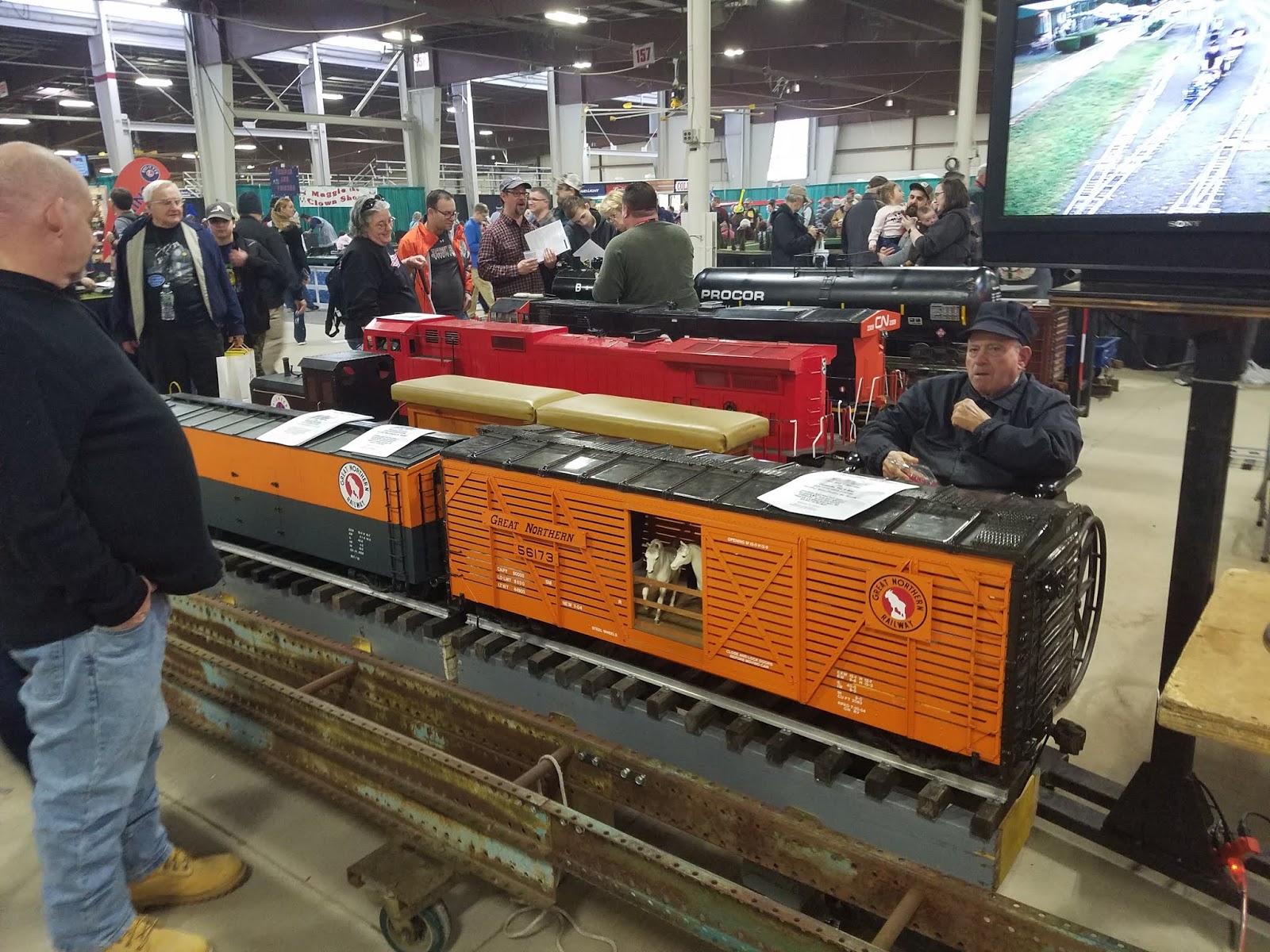
Live Steamers clubs shows off some of their very impressive rolling stock

And Engines... This has been a show favorite. Every year there is
another section built and on display.

Here are some of their engines!!

And Finally a small layout from the CogRailway. with a working rack track!!


And Finally here is my Show haul:


A Book on Maine's OOB Trolleys ( a Family Vacation Spot), a Ertl T&F Trevor the traction engine for my brother, 2 New HO Scale T&F Rolling stock to add to the collection, a Micro Mark HO scale truck turner ( more on that in the future!!)  and Finally Bachman's HOn3 Rusty and Blue passenger coach.  Whats not shown is a special box used for holding HO scale engines and cars. I got it to hold the VRR Trains I am building.  

Overall a great day and I cant wait until next year. But until then See ya real Soon!!


Thursday, September 12, 2019

History of 3025 - "The Locomotive That Would Not Die" Part 4 - The Finale

Part-4 Reborn from FIRE


On October 11th and 12th of 2008 all motive power, rolling stock, and everything else once owned by the Knox and Kane Railroad were put up for auction. The railroads land was bought by the Kovalchick Corporation who removed all of the track and rails-to-trails path was built, Engine number 38 was purchased by the Everett Railroad of Holidayburg, PA, and the remaining rolling stock was bought up by other railroad operation. But what happened to Engine number 58? The last time we talked about it it was a burnt pile of metal and rust.

As the title of this story has implied this was not the end of the line for the poor old engine. Knox and Kane Engine 58 was bought by non other than the Valley Railroad Company. Under the guidance of then Chief Mechanical officer J. David Conrad, who was the one that started the process to build the original first USA SY locomotive, the Valley shop crew worked tirelessly thought the cold winter to ready thr engine for transport to her new home in Essex, CT.
EX KKRR 58 undergoing restoration in Valley Shops
Once in her new home the newly renamed Locomotive 3025, in remembrance of the New Haven Railroad's steam engines,  we rebuilt and restored over the course of 2-1/2 years. This is the parts where the Friends of the Valley come in. Like many things in at the railroad when there is work to get done the friends are there to lend a helping hand. The Friends worked together with the full time shop crews to bring this beautiful engine back to life. I wasn't apart of the Friends of this time but looking back I do remember seeing the progress during my many visits as a guest with Nana and Papa.
Dave Conrad supervising the reassembly of 3025's tires
Finally in November of 2011, after all the hard work and effort, Valley Railroad Engine 3025 rolled out of the shops under her own power. Ever since that day she has been a staple of the Valley's fleet and is an amazing engine to see in real life. 
3025 heading South over Essex Street, Deep River, CT


When I first started with the Friends I learned the history of the 3025 and being able to help keep her running has been like a boyhood dream.  This is why I think I choose to create a model of 3025. To me it was really the first engine that I got to say I helped work and one could say it was my "one little spark" of inspiration for me to get serious in model making. Now I have skipped a few details in this story and I encourage you to do some research on your own to fill in some of the gaps. Thats part of the fun in this hobby. Trying to find that one little article or story that might lead you to one more little piece and soon you will have the whole history.  I hope this little bit gives you a taste of the many reasons why I want to make a miniature of this engine; in addition there is nothing like seeing the real thing. I invite you to come down to the Valley and see 3025 in person. We are heading into one of the most magical times at the Valley where you will get to see all 3 of the Valley's Steamers in action during the North Pole Express.  I hope you have enjoyed reading this and until next time: Hope to see you on the Valley.

Tuesday, October 30, 2018

History of 3025 - "The Locomotive That Would Not Die" Part 3

Part-3 Troubled times in PA, High winds and Fires


In my last post we talked about the Valley's original SY engine  No. 1647M and its sister 1658M. After both being unloaded in New Jersey the twin sister parted ways. If you remember 1658M was headed for the Knox and Kane Railroad in Pennsylvania. The KKRR was a tourist line with over 90 miles long and located in northwestern Pennsylvania; operating between the towns of Knox and Kane with a later expansion to Mount Jewett. Originally  owned by the B&O and the Eire Railroads this tourist line traveled through the Allegheny forests and over the beautiful Kinzua Viaduct.

The Railroad has a few engines on its roster, a few diesels, but the main star was No. 38; a Ex-Huntington & Broad Top 2-8-0 consolidation. From opening day in 1987 No. 38 was the star of the show and would head the all day excursion train from Mount Jewett over the viaduct and back. Around the late 1980's the railroads owner, Sloan Cornell, wanted to find another steam engine to help out No.38 with the excursion duties. He made the decision to buy a brand new locomotive from China.

No. 38 EX-H&BT 2-8-0


                                       (Now where have I heard this before...hmmmm)

So in 1990 just like her sister 1647M, the new Knox and Kane Railroad No.1658 arrived on the railroad. This was the start of the KKRR's glory days. From this moment till 2002 the railroad was flooded with tourists wanting to ride behind the two steam engines, marvel over the brand new Chinese engine, and especially in the fall foliage, enjoy the ride over the famous Kinzua bridge. However the glory days would not last forever.
No. 1658M SY 2-8-2

No. 1658M rolling over the Kinzu Viaduct


Near the end of 2002, state inspectors became concerns about the structural integrity of the the bridges supports. Closing the bridge to both railroad foot traffic for inspection and in 2003 a restoration plan was put into effect; but the bridge was running out of time. In July of that year a F1 tornado hit and destroyed the center span of the bridge.

Kinzu Bridge After the F1 Tornado


The railroad tried to survive from then by still running trains up to the bridge but without the attraction of having the train run over it; the journey wasn't the same. With less visitors and profits falling in 2006 the railroad had to officially shut its doors. The engines where but into storage at the engine house and awaited their fates.The final blow to the railroad happen in March of 2008. The engine house that was storing the locomotives was set on fire by arsonists. The fire damaged or destroyed the engines, including the new engine No. 1658M, and a majority of the coaches causing over one million dollars worth of damage. This event forced the railroad to have a total liquidation sale of all of their assets, land, buildings , engines, rolling stock, new and damaged goods, everything. The Knox and Kane was officially gone. Rails ripped up and properties gone, however among all of this negativity, there was a little spark of hope for one of their engines.....


No.1658M and whats left of the engine sheds

For more history and to see where I learned some of this information check out this video by Mike Adams about the KKRR:  Video
BUT MAKE SURE TO STOP AT 19:51 IF YOU DON'T WANT TO SPOIL THE NEXT POST!!

But till then, see ya real soon!

Saturday, October 27, 2018

History of 3025 - "The Locomotive That Would Not Die" Part 2

Part 2 - Sisters

Before I go any further with 3025's journey to the valley I need to mention a very critical element to this story. 3025 had a sister that lived on the valley before her.

Also before I start today's post. I have to give credit to where I learned about this information. In late 2017 there was an amazing book titled, "Along the Valley Line. The history of the Connecticut Valley Railroad" written by local historian Max Miller. It is an absolutely amazing book and is worth the read for anyone who is a fan of railroading. You would never believe how much could happen along our little hometown line and this post contains information from only one small section of the book. There is just too much good information. if you would like to get a copy of the book you can find it at the link below or see if Max will be having any events/talk about the book soon where he can sign your book as well. So a big Thank you to Max for the wonderful information that helped me in this project!!    Find the book here > Link:

Anyways back to our story. Turn the clock back to 1985 the Valley was looking to obtain a new steam engine to add to the roster. It took 4 years but with the help of at the time board member Bob Bell and chief mechanical officer J. David Conrad; the valley was able to order a engine from the Tangshan Locomotive & rolling stock Works. The engine's plans had to be converted from metric to imperial units and modified to be up to ASME ( the American Society of Mechanical Engineers) standards from locomotive and welded boilers. Other modifications to the locomotive where thicker firebox sheets larger crown stay bolts. The engineer and firemen controls where also switched to the other side of the cab to match American standards. All of these and a bit more became the valleys new engine, SY1647M!  ("SY" meaning the style or class of engine and the "M" standing for "Meiguo" or  "Beautiful Country", America).  Now while all this was going on the Chinese shops also built a twin sister engine, SY1658M for the Knox & Kane Railroad located in Pennsylvania.  (This is important for later, "hint hint")

Once the two engines, as well as a another engine of a different class heading to California, board a cargo ship heading for the USA. After dropping of the third engine in California  the two sisters headed though the panama canal and where unloaded at the Port of Camden, New Jersey. This is where the sisters parted ways and headed to their respected new homes and on April 21st, 1990 1647M with its's shiny new bell started her life along the valley line.


1647 worked on the Valley for about two years before there came a call and offer from the Susquehanna Railroad of Syracuse, NY. They had just order another SY locomotive, No.141, from China but sadly it was lost at sea when the ship holding it sank in the Bay of Bengal. Valley 1647M was sold and moved to her new home and renumbered No. 142. No. 142 still runs today and is part of the Belvidere Delaware Railroad and runs in the summer to Oct.


But what does this have to do with 3025? Remember 1647's sister in Pennsylvania? Well I shouldn't say more or I might spoil my next post.


Saturday, September 29, 2018

History of 3025 - "The Locomotive That Would Not Die" Part 1

Part 1 - Origins and Classifications

After deciding that my first project was going to be 3025 I needed to start on some research about the engine and how in the world was I going to create a working HO scale model of it!?!?

VALE 3025 has had a interesting and troubled past before its working life here in Connecticut and I think its one of the reasons I choose to model this engine. Believe it or not 3025 is the youngest steam engine at the Valley as well as one of the youngest in the USA. It was built in July of 1989 by the Tangshan Locomotive & Rolling Stock Works located in Tangshan, Hebei, China. Yes, you read that correctly the engine was make in China!!! Tangshan starting building steam engines during the 1880 and was the last factory in the world build brand new steam engines up until the year 1999.

In America and other parts of the world; steam engines are categorized into classes based on their wheel arrangement. Normally they are arranged by 3 numbers and the name of that class. 3025 has 2 wheels under it's smoke-box, 8 driving wheels under the boiler, and 2 more wheels under the firebox/cab. This would be called a two-eight-two (2-8-2) or a "Mikado" type locomotive.
Here is a chart showing other groups of
Locomotive wheel arrangements and their names.
 The Mikados were first built by the Baldwin Locomotive Works for Japan and got their classes name from what the Japanese Emperor was often referred by during the late 1890's. The Mikado class of engines were a improvement of the 2-8-0 consolidation class locomotives. They proved to be great engines for fast and heavy frights during the transition era from steam to diesel power. With their power, versatility and smoother running this class of engine became a standard design around the world. Even today many tourist railways have this or similar classes of engine because of these factors.